New Horizon Europe Project SPARK4B+ [29.09.26]
How can alternative socio-economic approaches and governance frameworks help protect and restore biodiversity while advancing more equitable and just futures? And how can these alternatives be turned into concrete pathways for change? These are among the central questions addressed by SPARK4B+, a new four-year Horizon Europe project involving 17 consortium partners from across Europe and beyond. The project combines quantitative and qualitative approaches, modelling and stakeholder co-creation to develop and test alternative pathways towards biodiversity-positive and just futures.
The Chair of Ecological-Economic Policy Modelling at the University of Hohenheim is part of the consortium, contributing expertise in ecological-economic modelling and biodiversity-friendly agriculture. Across six case studies in different countries and sectors, the Hohenheim team leads the German case study in Hohenlohe.
In the German case study, the team will investigate cooperative approaches to biodiversity management at the landscape scale. The research will explore how farmers and other local stakeholders can coordinate biodiversity measures across farm boundaries to strengthen ecological connectivity in intensively farmed landscapes. The case study will focus, among other things, on measures such as flower strips, extensive grassland management, fallows and semi-natural habitats, with particular attention to pollinators, farmland birds and other species.
The work builds on a dialogue forum initiated through the BEATLE project at the chair, providing a foundation for further research on collective biodiversity action in agricultural landscapes.
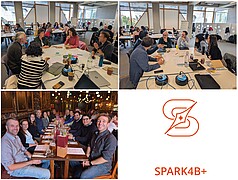
The SPARK4B+ kick-off meeting took place from 9–11 September at Coventry University, bringing together the consortium partners at the start of the four-year project. Simone Melder, Mansi Nagpal and Arndt Feuerbacher from the Chair of Ecological-Economic Policy Modelling represented Hohenheim at the meeting, where partners discussed the research activities and next steps for the project.
Follow SPARK4B+ on LinkedIn and visit the project website for updates and insights from the project.
Back to News